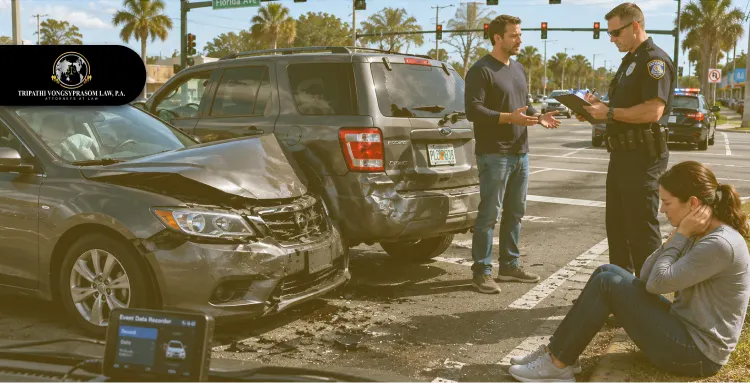
Rear-end car accident scene with police investigation, damaged vehicles, and injured individuals documenting evidence for insurance and personal injury liability claims.
Personal Injury | Auto Accidents | Polk County, FL
Rear-End Collision Liability: Who Is at Fault and Why It Matters
TripVien Law | Lakeland, FL | Serving Polk County | Updated 2026
In a rear-end collision, the rear driver is almost always assumed to be at fault for following too closely and not stopping. The liable party is the one who pays for the damages. The insurance of the driver at fault will pay for medical bills, vehicle repair, and lost wages for all involved.
Key Takeaways
- Fault in rear-end collisions is legally defined, not just by impact.
- The rear driver is usually at fault, but this can be challenged with evidence.
- In Florida, your compensation is reduced by your fault percentage.
- Florida's HB 837 allows just two years from the accident date to file a negligence lawsuit.
- Minor crashes can still cause serious injuries, so always obtain a medical report.
- Sudden braking, faulty brake lights, and unsafe lane changes can shift fault to the front driver.
- The vehicle's black box can clarify events just before impact.
01
Who Is To Blame In A Rear-End Collision?
Most of the time the rear driver is at fault. That is where we start. The law says that every driver should keep a distance from the car in front and be ready to stop the car at any moment. Florida Statute 316.0895 requires drivers not to follow another vehicle more closely than is reasonable and prudent.
The law expects every driver to do this. According to the National Highway Traffic Safety Administration, distracted driving endangers drivers, passengers, pedestrians, and others on the road. If you hit someone from behind, the first presumption of fault will usually go to you because you may have been too close or not paying attention.
Let us say traffic slows near a busy Lakeland intersection. The car ahead brakes, and you do not react in time. That is on you. The rule exists because drivers control their following distance, not the driver ahead.
However, here is where it shifts. The front driver is not always innocent. If the driver in front makes a lane change without enough space, then it is likely that driver in front will be at fault, not the one behind. Someone can cut you off on Florida Avenue and slam on the brakes. You hit them. That is not clean fault anymore.
Comparative Negligence
This presumption is rebuttable and can be challenged with the right evidence. Comparative negligence means more than one party can share blame. If you were slightly close, but the front driver acted recklessly, fault gets split. This directly affects your final compensation.
Common causes behind these crashes stay consistent. Distracted driving, speeding, bad weather, and sudden stops are common causes. The main thing to remember is that we assume the rear driver is at fault, but that is not always the final ruling. It is a starting point.
Also Read
02
Why Determining Fault Matters After Rear-End Accidents
Right after a crash, most people think about damage and injuries. However, the real fight starts later. Two similar accidents can end very differently just because fault was handled right in one and ignored in the other.
Fault decides everything. It controls who pays for medical bills, car repairs, and lost income. Around Lakeland, insurance companies move quickly to assign blame, often before the full story is clear. If you get labeled at fault early, reversing that decision becomes harder.
Hidden Injuries - Do Not Overlook Them
How State Laws Affect Fault in Rear-End Collisions
State law plays a huge role here. Florida follows a modified comparative negligence system. That means your compensation is reduced by your percentage of fault. Under Florida Statute 768.81, a party found greater than 50 percent at fault for their own harm may not recover damages in many negligence cases.
In practical terms, if you are found 30% at fault, you lose 30% of your compensation. That is why proving details matters. One small factor, like faulty brake lights, can reduce your share of fault. Liability is what drives the outcome.
Important Deadline
03
When It's Not Your Fault In The Accidents
Sometimes the story changes. The driver who is behind is not always at fault. These situations happen more often than people think. They are common in places like Polk County.
I
Sudden and Unnecessary Braking
If the lead driver brakes hard without a valid reason, it can create an unavoidable crash. Think of someone brake-checking in traffic. That behavior shifts liability toward them.
II
Front Driver Reverses Into You
This happens in parking lots and at stoplights. If the front vehicle suddenly moves backward, the rear driver is not responsible. The motion itself proves fault.
III
Faulty Brake Lights or Signals
Faulty brake lights are basic communication on the road. If they do not work, the rear driver has no warning. The front driver's negligence becomes a key factor.
IV
Unsafe Lane Changes
When a driver makes an unsafe lane change without leaving enough space and then slows down, that driver is at risk of sharing or carrying fault.
V
Road Hazards or External Factors
Debris, poor road conditions, or sudden obstacles can force abrupt stops. Sometimes liability extends to third parties responsible for road safety.
VI
Chain-Reaction Crashes
In multi-vehicle chain-reaction crashes, fault rarely belongs to one person. Lawyers need to figure out what started the sequence and how each driver contributed.
Also Read
04
How Do Insurers Determine Who Was At Fault?
Insurers check the facts, not just how bad something looks. Insurance companies have a step-by-step way of doing things even if it seems like they are in a hurry.
1
Driver Behavior
Was the driver distracted, speeding, or tailgating?
2
Vehicle Position
Where did the impact happen and how severe was it?
3
Road Conditions
Stormy weather, lighting, or bad traffic patterns?
4
Evidence
Photos, videos, witness statements, and police reports.
5
Vehicle Condition
Are there issues with brake lights, tires, or mechanical error?
Event Data Recorder (EDR) - The Black Box
05
How Do You Challenge Fault In A Rear-End Collision?
If you want to challenge fault, you need more than a statement. You need proof that tells a clear story.
01
Collect Evidence at the Scene
Photos, videos, and damage angles matter. Capture everything, including road conditions and signals.
02
Get Witness Statements
Independent witness statements carry weight. They can confirm sudden stops or unsafe driving.
03
Secure Camera Footage
Traffic camera footage and nearby businesses often record accidents. This is one of the strongest forms of proof.
04
Use Vehicle Records
Maintenance records can show your car was functioning properly. The importance of preserving vehicle maintenance records cannot be overstated.
05
File a Police Report
Police reports document facts, statements, and initial observations. Insurers rely heavily on them.
06
Hire a Lawyer Early
This is where most people delay, and it costs them. Attorney intervention allows for proper evidence gathering and challenges to fault before it becomes fixed.
At our firm, TripVien Law in Lakeland, we handle these cases with a focus on liability strategy, not just paperwork. If you are dealing with a rear-end collision and the fault is unclear, reach out early.
TripVien Law | Rear-End Collision Defense
Fault Is Not Fixed Until You Fight It
We handle the liability strategy so you can focus on recovery. Lakeland and Polk County accident clients can contact TripVien Law today.
Contact TripVien Law Today >>Lakeland & Polk County, FL
tripvienlaw.com
Frequently Asked Questions
Rear-End Collision Liability FAQs
Q: Why should you never admit fault?
A: Because fault is a legal determination, not a personal opinion. Saying the wrong thing can be used against you later.
Q: After the collision, whose insurance company should I call?
A: Notify your own insurer first. However, the at-fault driver's insurance typically pays for damages.
Q: What not to say to the insurance adjuster?
A: Avoid guessing, admitting blame, or downplaying injuries. Stick to facts only.
Q: What's the biggest mistake people make in a claim?
A: Waiting too long to gather evidence or seek legal advice. Early mistakes are hard to fix.
Q: What happens if insurance cannot determine fault?
A: They may assign shared fault or deny parts of the claim. This often leads to disputes.
Q: Should I tell my insurance about a non-fault accident?
A: Yes. Always report it. Delays can affect your coverage and claim process.
TripVien Law | Personal Injury & Auto Accident Attorneys
Lakeland & Polk County, Florida | tripvienlaw.com
Disclaimer: This blog post is for informational purposes only and does not constitute legal advice. For specific guidance on your case, please consult with a licensed attorney at TripVien Law.