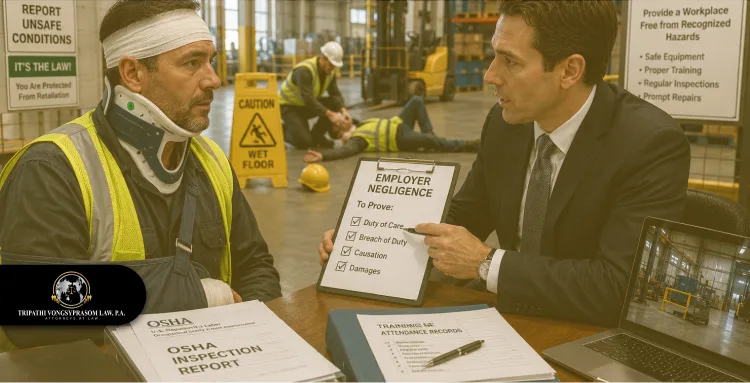
Workplace injury consultation showing an attorney reviewing employer negligence, OSHA violations, and injury evidence for workers' compensation and personal injury claims.
Workplace Injury | Employer Negligence | Legal Evidence
Proving Employer Negligence in Workplace Injury Cases
A Strategic Legal Guide for Injured Workers
To prove employer negligence, you must show that your employer failed to keep you safe and that this failure directly caused your injury. Key evidence includes OSHA reports, maintenance logs, and witness statements. A successful case can get you much more than a standard workers' compensation payout.
Key Takeaways
- Every employer is legally required to maintain a safe work environment under the duty of care standard.
- A breach of duty occurs when employers knowingly ignore hazards to prioritize production or cost savings.
- OSHA records, maintenance logs, training attendance, and surveillance footage are critical evidence.
- Proving negligence can express compensation far beyond basic workers' compensation, including pain, suffering, and punitive damages.
- Federal and state laws protect employees from retaliation when they report unsafe conditions.
01
Employer Duty of Care in Workplace Injury Cases
Establishment of a successful claim begins with a study of the basic protections every employee deserves under the law. We examine these protections to identify exactly where the company fell short of its legal requirements.
Definition of Legal Obligation
Every employer in the country operates under a specific legal promise. This promise ensures that they maintain an environment that protects the well-being of every team member. Lawyers often refer to this as the duty of care in the workplace.
- Identify potential hazards in the workplace.
- Provide necessary personal protective equipment (PPE).
- Ensure all staff receive adequate safety training.
- Maintain equipment to prevent mechanical failure.
2.6 Million
Nonfatal workplace injuries and illnesses reported in 2023
Source: BLS
Source: Bureau of Labor Statistics.
02
How Employers Breach Safety Duties at the Work Environment
Negligence usually happens when a company puts how fast it can make things over the safety of the people operating the equipment. We dig into reports of corporate greed causing avoidable physical injuries.
Identification of Intentional Neglect
We are interested in anything suggesting the company knowingly disregarded a risk. Maybe they did not perform a required preventive check so they could continue the production line, or they avoided fixing a broken ladder so they could save money.
03
Evidence to Prove Employer Negligence
Evidence in these cases is rarely found in a single document. It is built through a careful review of multiple records. We piece together these reports to show a complete picture of the employer oversight.
Utilization of Federal Safety Records
One of the most powerful tools in our investigation is the collection of OSHA violation reports. The Occupational Safety and Health Administration sets the gold standard for safety in the United States.
Analysis of Internal Maintenance Logs
Apart from the government reports, we also examine internal documents. These are often called workplace safety records. These files include service records for heavy machinery and logbooks detailing when a hazard was reported.
We also check attendance records for mandatory safety training sessions and purchase orders for safety gear. When these records are missing or incomplete, it often points directly to corporate negligence.
We work quickly to secure surveillance footage before the company deletes it or records over it. See how evidence and liability differ in complex cases like truck accidents in Florida.
Key Evidence Types in Employer Negligence Cases
| Evidence Type | What It Includes | Why It Matters |
|---|---|---|
| OSHA Violation Reports | Federal government records documenting safety rule breaches | Proves a history of endangering workers |
| Internal Maintenance Logs | Service records for heavy machinery and hazard logbooks | Shows ignored or delayed safety repairs |
| Safety Training Records | Attendance records for mandatory safety sessions | Reveals gaps in required worker training |
| PPE Purchase Orders | Records of safety gear procurement | Exposes failure to equip workers properly |
| Surveillance Footage | Video from warehouses, loading docks, and offices | Captures incident conditions and missing safeguards |
| Witness Statements | Testimony from coworkers about known hazards | Confirms supervisors were aware of dangers |
$165,514
Maximum penalty per willful or repeat OSHA violation in 2025
Source: OSHA
Source: Occupational Safety and Health Administration.
04
Specific Requirements to Prove Employer Negligence
Movement beyond a simple insurance claim requires fulfillment of a set of strict legal criteria that prove fault.
Burden of Proof Standards
You need to prove that the employer's actions were more than just an honest mistake. You must show that their specific failure directly caused your harm.
Related Legal Guidance
Compensation Beyond Basic Insurance
The rewards of a successful lawsuit are much higher than a basic claim. A negligence lawsuit can cover:
- Total compensation for past and future pain and suffering.
- Long-term emotional trauma and the loss of enjoyment in your life.
- Punitive damages to punish the employer for intentional or reckless negligence.
05
Witness Testimony and Accident Scene Evidence
When something unusual happens, there might be people who were there and can explain what really went on. We try to preserve all the details before the company can change them.
Power of Eyewitness Testimony
We rely heavily on witness statements for work accidents. Your coworkers often see things that supervisors want to ignore. They might remember a warning about a loose railing or a manager telling workers to move faster despite the rain.
We interview these individuals immediately to capture the truth before memories fade.
Security for Digital Proof
Surveillance footage is extremely important for injury claims. Many workplaces have cameras in warehouses, loading docks, and offices. This video gives us a picture of what happened right before someone got hurt.
06
Employer Liability and Corporate Responsibility in Workplace Injuries
A company is more than just a name. It is a collective of decisions made by leadership that affect every employee. We hold the organization accountable for the choices made at every level of the business.
Leadership and Vicarious Liability
In workplace accident cases, one of the most important legal concepts to understand is vicarious liability. Simply put, a company does not get to walk away from responsibility just because a manager or supervisor made the harmful decision. The organization itself can be held accountable for choices its leaders make on the job.
Protection from Employer Retaliation
Many workers are afraid to speak up when their workplace is unsafe. They worry that their employer will fire them or make their life at work difficult. However, the law is on your side. OSHA worker rights guidance explains that employers may not retaliate against workers for using safety rights.
Retaliation Warning
$161.5B
Cost of work-related injuries to the U.S. economy in 2022
Source: NSC
2.6M
Nonfatal workplace injuries and illnesses reported in 2023
Source: BLS
Sources: National Safety Council Injury Facts and Bureau of Labor Statistics.
How TripVien Law Proves Causation in Workplace Injury Cases
A successful case must show that the employer's failure was the direct engine behind your physical injuries. We use expert analysis to bridge the gap between their negligence and your resulting medical condition.
Establishment of Causation
Every successful case needs proof of the proximate cause in injury claims. This legal term means we must show a direct link between the employer's negligence and your specific harm.
Foreseeable Risks and Preventable Tragedies
If an ignored risk or unsafe environment caused your injury, you deserve an honest look at the facts. Hardam and Viengphone from TripVien Law review your situation to see how to help you recover.
Contact TripVien Law Today
Injured at Work Because Safety Was Ignored?
Hardam and Viengphone from TripVien Law review unsafe workplace facts, preserve evidence, and help injured workers understand the next legal step.
Message Us Today >>Website: tripvienlaw.com
Frequently Asked Questions
Employer Negligence and Workplace Injury FAQs
Q: What is the duty of care in the workplace?
A: Every employer in the United States operates under a legal requirement to maintain a safe work environment. This includes identifying hazards, providing protective equipment, delivering proper safety training, and maintaining all machinery.
Q: What is the difference between workers' compensation and a negligence lawsuit?
A: Workers' compensation typically pays regardless of who is at fault and covers basic medical and wage benefits. A negligence lawsuit requires proving that the employer's specific failure caused your harm. However, it can deliver far greater compensation, including damages for pain and suffering, emotional trauma, and in some cases, punitive damages.
Q: What types of evidence are most important in an employer negligence case?
A: The most important evidence includes OSHA violation reports, internal maintenance logs, safety training attendance records, PPE purchase orders, surveillance footage, and eyewitness testimony from coworkers.
Q: Can I be fired for reporting an unsafe workplace?
A: No. If an employer fires or demotes you for reporting a safety concern, that action itself may give rise to additional legal claims.
TripVien Law | tripvienlaw.com | Protecting Injured Workers
Contact TripVien Law Today | Website: tripvienlaw.com | Message Us: tripvienlaw.com/contact-us
Disclaimer: This blog post is for informational purposes only and does not constitute legal advice. For specific guidance on your case, please consult with a licensed attorney at TripVien Law.