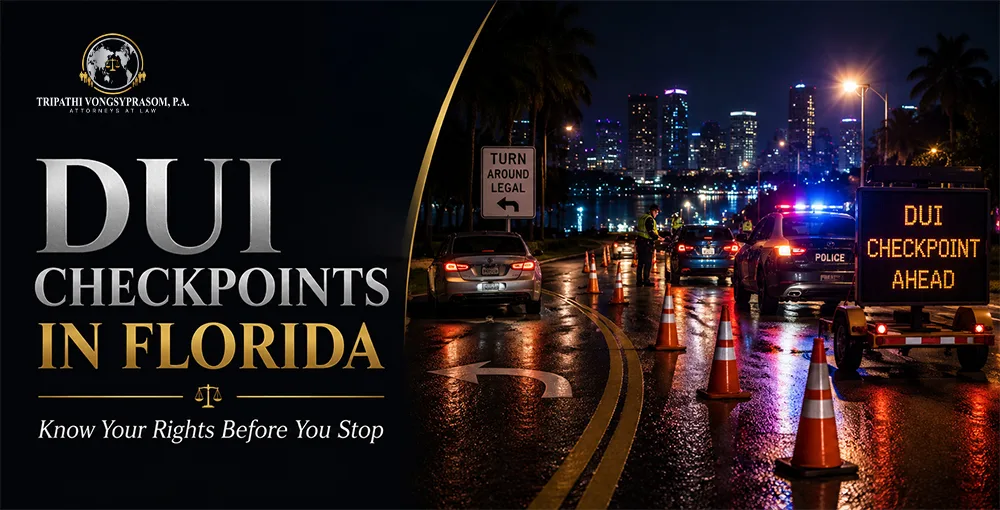
Legal information graphic explaining DUI checkpoints in Florida and the rights of motorists during sobriety stops. The image depicts a nighttime DUI checkpoint with law enforcement officers, traffic control measures, and checkpoint signage, highlighting legal considerations, constitutional rights, checkpoint procedures, and what drivers should know before encountering a DUI roadblock.
DUI Defense | Florida Sobriety Checkpoints
DUI Checkpoints in Florida: Are They Legal and Can You Avoid Them?
TripVien Law, P.A. | Florida DUI Defense and Traffic Stop Strategy
Quick Answer
DUI checkpoints are legal in Florida. You can legally avoid one before reaching it if your turn is lawful and safe. But once an officer directs you into the checkpoint lane, you must stop and provide required driving documents. Police also have to follow strict rules, and one procedural mistake can become a powerful DUI defense.
Key Points
- Florida allows DUI checkpoints. Sobriety roadblocks are legal when police follow constitutional rules.
- You may turn away before the checkpoint. The turn must be lawful, safe, and not create a separate traffic violation.
- Police must limit discretion. Checkpoint stops should follow neutral, pre-set procedures.
- Brief detention matters. A driver should not be held longer without reasonable suspicion.
- Field sobriety tests are different from post-arrest chemical tests. Refusing each one can create very different consequences.
- Bad procedure can change the case. Advance notice failures, vague observations, and testing issues can support a defense.
By The Numbers
38
States generally allowing sobriety checkpoints
15-20
Approximate monthly Florida checkpoints cited in the source PDF
3 Min
Maximum initial detention emphasized in Florida checkpoint guidance
Legal references include Michigan Dept. of State Police v. Sitz, Florida Statute 316.1932, and Florida Statute 322.2615.
1. Are DUI Checkpoints Actually Legal in Florida?
Yes. Florida is one of the states where DUI checkpoints can be used as a law enforcement tool. The federal constitutional baseline comes from Michigan Dept. of State Police v. Sitz, where the U.S. Supreme Court addressed sobriety checkpoints and Fourth Amendment concerns.
Florida courts then built their own checkpoint limits. In Florida, the key issue is not simply whether a checkpoint exists. The real issue is whether the agency planned it, announced it, staffed it, and ran it under neutral procedures that limit officer discretion.
Legal But Not Unlimited
A legal checkpoint is not a free-for-all. If the roadblock lacks advance guidelines, neutral vehicle selection, proper notice, or a brief detention process, a DUI attorney can challenge the stop and the evidence collected from it.
If you want a broader look at penalties, arrest issues, and defense strategy, review the TripVien Law DUI Defense practice area. Checkpoint cases often overlap with license suspension, criminal exposure, and immigration concerns for non-citizens.
2. What Rules Must Florida Law Enforcement Follow at Checkpoints?
Florida law does not let officers create a roadblock on impulse. A valid checkpoint usually depends on advance planning and written limits. The goal is to prevent arbitrary stops and keep the checkpoint focused on roadway safety rather than officer guesswork.
- Advance public notice. Agencies should announce checkpoint plans before the first car reaches the cones.
- Written operational guidelines. Supervisors should set the plan in advance, including location, time, and vehicle selection method.
- Neutral vehicle selection. Officers should stop cars by a fixed pattern, not by appearance, background, or hunch.
- Short initial contact. The checkpoint encounter must stay brief unless an officer develops reasonable suspicion.
- Clear signs and safety controls. Drivers should be able to identify the roadblock and move through it safely.
Public notice is especially important. Some Florida agencies publish specific notices before checkpoints, and those notices may explain that drivers will see signs or can choose an alternate route before entering the checkpoint area. One example is this Jacksonville Sheriff's Office sobriety checkpoint notice.
Skipping even one rule can matter. When the procedure is sloppy, the defense may argue that the stop lacked constitutional standing. That can put observations, statements, field exercises, and chemical test evidence at risk.
Florida DUI Arrest Risk
Relative Checkpoint Activity by Holiday and Traffic Pattern
Based on the source PDF's Governors Highway Safety Association and TripVien Law case intake reference.
New Year's Eve
Very High
July 4th
Very High
Memorial Day
High
Labor Day
High
Thanksgiving
High
St. Patrick's Day
Elevated
Regular Weekend
Moderate
Weeknight
Low
3. Can You Legally Avoid a Florida DUI Checkpoint?
Yes, if you do it legally. A calm, lawful turn before the checkpoint is not automatically suspicious. But an illegal U-turn, cutting through private property, ignoring traffic signs, swerving suddenly, or stopping hard on the shoulder can give officers a separate reason to pull you over.
The distinction is practical. You can choose another route. You cannot create a new traffic violation while doing it. If the officer sees unsafe driving, squealing tires, erratic lane movement, or a violation near the checkpoint, the stop may be based on that conduct rather than the checkpoint itself.
If you were cited near a roadblock, the traffic violation can affect both the DUI case and your driving record. TripVien Law also handles Florida traffic ticket defense when checkpoint encounters turn into citations.
Arrested at a Florida DUI Checkpoint?
The procedural rules are strict. If law enforcement got the checkpoint wrong, your case may be defensible or dismissible.
Schedule Your Free Consultation >>4. What Are Your Rights When Officers Stop Your Car?
The checkpoint encounter is supposed to be brief. Officers look for signs of impairment while they ask for basic documents. They may observe how you speak, how you hand over your license, whether they smell alcohol or cannabis, and whether there are other visible red flags.
But you do not have to turn a document check into a conversation. You must provide required driving documents. You are not required to answer broad questions about where you are going, where you came from, or what you drank.
Driver Rights Snapshot
| You Must | You May Refuse |
|---|---|
| Stop if directed by an officer | Answer questions beyond document requests |
| Provide license, registration, and insurance | Take field sobriety tests before arrest |
| Remain briefly if selected by the checkpoint pattern | Consent to a vehicle search without a warrant or exception |
| Comply with a lawful post-arrest chemical test request or face refusal penalties | Turn around before reaching the checkpoint if the maneuver is legal |
Silence Is Not the Same as Noncompliance
Hand over your license, registration, and insurance. Then keep your answers short. Politely saying that you do not want to answer questions is very different from arguing, resisting, or refusing to provide required documents.
5. Should You Answer Their Questions at a Checkpoint?
No, not beyond the document request. Many drivers feel social pressure to explain themselves. That pressure is not law. The safest approach is usually calm, minimal, and precise: provide the required documents and avoid making statements that later become evidence.
Some drivers use a printed rights card. That can be lawful, but it should be done calmly. The goal is to avoid unnecessary statements, not to escalate the stop. Tone matters because officers often cite nervousness, unusual behavior, or communication issues when they try to justify a secondary DUI investigation.
Our Survey Finds
A review of TripVien Law checkpoint intake data found that more than 60% of clients who contacted the firm after a checkpoint DUI arrest were moved into a secondary investigation because of behavioral cues, not hard proof of impairment. Tired eyes, nervous speech, and fumbling for a license often became the reason for deeper scrutiny.
6. Field Sobriety Tests vs. Breathalyzers: What Is the Difference?
Field sobriety tests are roadside exercises. They can include walking a line, standing on one leg, following a stimulus with your eyes, or performing other tasks while an officer watches. In Florida, these exercises are generally voluntary before arrest.
Breath tests are different after a lawful DUI arrest. Florida's implied consent statute says that a person who drives in Florida is deemed to have consented to approved breath, urine, or blood testing under the statute's conditions. The Florida Senate text for section 316.1932 explains the warnings and refusal consequences.
Attorney Perspective
"Our clients often do not realize that refusing a field sobriety test and refusing a breathalyzer carry very different legal consequences. One is usually voluntary. The other can trigger automatic penalties after a lawful arrest."
- Attorney Vongsyprasom, TripVien Law, P.A.
Testing Comparison
| Issue | Florida Rule | Defense Concern |
|---|---|---|
| Field Sobriety Tests | Usually voluntary roadside exercises | Poor lighting, uneven pavement, nerves, and medical conditions can affect performance |
| Post-Arrest Breath Test | Covered by Florida implied consent rules after lawful arrest | Refusal can trigger automatic suspension and may be used as evidence |
| Vehicle Search | Requires consent, probable cause, warrant, or another legal exception | You may clearly refuse consent to search |
| Checkpoint Detention | Must remain brief unless reasonable suspicion develops | A long wait can become a defense issue |
Florida administrative suspension rules are also strict. Under Florida Statute 322.2615, refusal to submit to a lawful breath, blood, or urine test can mean a one-year suspension for a first refusal and 18 months if the driver has a prior refusal suspension.
7. What Can Get a Checkpoint DUI Charge Dismissed?
Checkpoint DUI arrests are more defensible than many drivers expect. The government must justify the roadblock and the later DUI investigation. Every step has to hold up: planning, public notice, neutral vehicle selection, officer observations, detention time, testing procedure, and documentation.
- No proper advance notice. If the agency failed to publish or document the checkpoint notice, the stop can be challenged.
- No neutral stopping pattern. Random officer choice can undermine the constitutional basis for the roadblock.
- Detention went too long. Holding a driver without reasonable suspicion can make later evidence vulnerable.
- Weak impairment observations. Nervous speech, tired eyes, or fumbling for documents may not be enough by themselves.
- Testing problems. Breathalyzer maintenance, calibration, operator permits, and test procedure all matter.
- Field test problems. Uneven pavement, poor lighting, medical issues, and unclear instructions can weaken the officer's conclusions.
Florida Defense Note
"I have seen checkpoint cases dismissed simply because the agency failed to post proper advance notice. The rules exist for a reason, and when agencies cut corners, defendants benefit."
- Florida Justice Association attorney commentary cited in the source PDF
If your case came from a sobriety roadblock, do not assume the arrest report tells the whole story. A defense review should request the checkpoint plan, notice records, supervisor instructions, officer assignments, breath machine records, body camera footage, and any documents showing how vehicles were selected.
Checkpoint Defense Review
The Operational Record Can Decide the Case
A checkpoint arrest is only as strong as the procedure behind it. TripVien Law can review the stop, testing record, and defense options quickly.
Request a Free DUI Consultation >>TripVien Law, P.A. | Florida DUI Defense
www.tripvienlaw.com
8. How Do You Find DUI Checkpoint Locations Before Driving?
Florida checkpoint notices may appear through agency websites, local news, social media, roadside signs, or public notice pages. Checking before a holiday weekend takes very little time and can prevent a stressful encounter.
Start with official law enforcement notices when available. Some third-party sites, including DUIBlock's Florida checkpoint listings, collect public checkpoint information, but those listings should be treated as awareness tools rather than legal advice.
The best prevention is still simple: do not drive after drinking or using any substance that affects your ability to operate a vehicle. If you are stopped, stay calm, keep answers brief, and talk to a DUI defense attorney before accepting a plea.
Build a Florida DUI Checkpoint Defense With TripVien Law
Florida DUI checkpoints are legal only when law enforcement follows the rules. You may be able to avoid a checkpoint legally before you reach it. You may refuse broad questioning and voluntary field exercises. But after a lawful DUI arrest, refusal of a required chemical test can trigger serious license consequences.
The most important point is this: checkpoint cases are not automatic convictions. A flawed plan, missing notice, extended detention, subjective observations, or testing problems can shift the entire case. TripVien Law reviews these details with the care they deserve.
If you were arrested at a DUI checkpoint in Florida, contact TripVien Law's DUI defense team to evaluate the stop, protect your license, and identify every available defense.
People Also Ask
Frequently Asked Questions
Q: Can you use Waze or Google Maps to avoid a Florida DUI checkpoint?
A: Yes. Public checkpoint information can be shared, and using a navigation app is not illegal. The risk comes from making an unsafe or unlawful maneuver after you see the checkpoint.
Q: Do passengers have to show ID at a DUI checkpoint in Florida?
A: Usually no, not merely because they are passengers. Police typically need a separate legal reason to demand identification from a passenger who is not suspected of violating the law.
Q: Can police use a drug dog during a routine checkpoint stop?
A: A dog sniff cannot normally be used to prolong a routine stop without legal justification. If officers detect an odor or another specific fact, the encounter may change.
Q: What happens if you have a medical marijuana card and the car smells like cannabis?
A: A medical marijuana card does not give permission to drive impaired. Cannabis odor can lead officers to investigate further under Florida law.
Q: Can you refuse field sobriety exercises in Florida?
A: Field sobriety exercises are generally voluntary, and many DUI defenses focus on how subjective these tests are. Chemical testing after a lawful DUI arrest is different.
Q: Can a Florida DUI checkpoint case be dismissed?
A: Yes. If the roadblock lacked proper notice, neutral guidelines, lawful detention, or reliable testing, a defense attorney may challenge the stop and the evidence that followed.
Disclaimer: This blog post is for informational purposes only and does not constitute legal advice. For specific guidance on your case, please consult with a licensed attorney at TripVien Law.