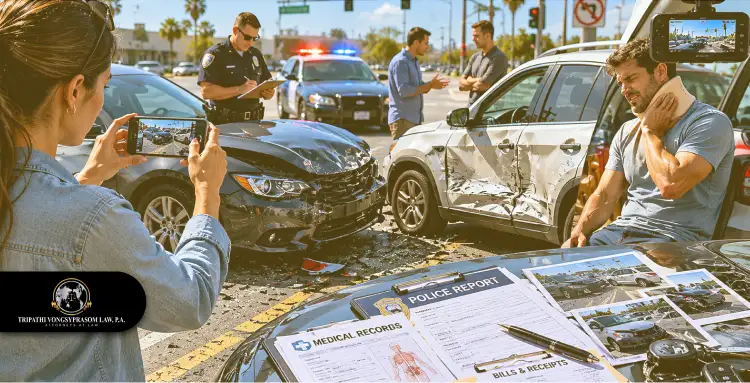
Detailed car accident scene showing vehicle damage, police investigation, medical records, and photo evidence used to strengthen personal injury and insurance compensation claims.
Personal Injury Law | Florida Car Accidents
What Evidence Strengthens Your Car Accident Case the Most?
TripVien Law, P.A. | Florida Injury Claim Support
Quick Answer
A car accident case is won by proof. Medical records, a police report, photos, videos, witness statements, and financial documentation form the strongest evidence in a Florida car accident case. Together, they prove fault, connect the crash to your injuries, and show exactly what the accident has cost you.
Key Takeaways
- A police report gives your car accident case structure and credibility from day one.
- Photos and videos freeze the scene before skid marks, debris, vehicle positions, and weather conditions disappear.
- Medical records directly link the crash to your injuries and show how serious the harm really is.
- Financial documentation turns vague pain into provable damages, including bills, lost wages, and out-of-pocket costs.
- Hidden evidence like EDR data, phone records, and surveillance footage can tip the scale in disputed Florida crash claims.
By The Numbers
29,135
People killed in U.S. crashes during the first 9 months of 2024
39,254
U.S. traffic deaths reported in annual 2024 data
1.19M
Approximate road traffic deaths worldwide each year
Sources: NHTSA first-nine-month 2024 estimate, NHTSA 2024 annual traffic fatalities, and World Health Organization road traffic injuries.
1. Does a Police Report Actually Help Your Car Accident Case?
A crash report does not automatically decide fault, but it gives the case structure. It records basic facts while they are still fresh: driver information, vehicle details, officer observations, witness names, citations, and the official crash timeline.
Florida treats crash reporting as a serious record-keeping step. The Florida Department of Highway Safety and Motor Vehicles explains that law enforcement must be notified for crashes involving injury, fatality, hit-and-run, DUI, a wrecker, a commercial vehicle, or apparent damage of at least $500.
Get the report, keep it, and review it for errors. Incorrect location details, missing witnesses, or unclear observations can give the insurance company an easy opening. Strong Florida car accident evidence starts with a clean record.
2. How Do Photos and Videos Strengthen a Florida Car Accident Claim?
Photos are powerful because they freeze the moment. Damage to both vehicles, skid marks, debris, lane positions, traffic signals, weather, road conditions, and visible injuries can all matter when an insurance adjuster later questions what happened.
Video can be even better. Dashcam footage, traffic-camera footage, or nearby business surveillance can quickly resolve arguments about speed, lane movement, braking, and impact angle. Save it right away when it exists.
Modern vehicles may also carry evidence that no one sees at the scene. NHTSA event data recorder material explains that EDRs may record pre-crash vehicle dynamics, driver inputs, crash signature, restraint use, and post-crash information.
3. Why Do Independent Witness Statements Matter in Florida Crash Cases?
Independent witnesses matter because they are not part of the dispute. A passenger can help, but a neutral bystander is often more persuasive. Witness names should appear in the official report, which is one more reason to collect them while people are still nearby.
Good witness evidence is simple and specific. Who had the green light? Which vehicle drifted? Was anyone speeding, braking late, or using a phone? These details strengthen a car accident claim without making it more complicated.
Expert Perspective
"In personal injury litigation, impartial witness testimony paired with physical evidence creates the most difficult cases for insurance adjusters to dispute. The combination shifts the burden entirely."
- Dr. Martin Engel, Forensic Accident Reconstruction Specialist, Florida
4. Why Are Medical Records the Core of Any Car Accident Injury Claim?
This part is huge. If the crash caused injuries, the medical file becomes one of the most important parts of the case because it links the collision to the harm. ER records, follow-up appointments, imaging, prescriptions, physical therapy notes, and doctor recommendations all show the nature and seriousness of the injury.
The stronger the treatment history, the harder it is for an insurer to wave the injury away as minor or unrelated. The sooner treatment starts, the easier it is to connect the crash to the symptoms. Delay creates doubt. Documentation builds trust.
If you are still in the early hours after a crash, start with this related TripVien guide on what to do after a car accident in Florida.
Legal Guidance
Your Evidence Window Is Closing Fast
Every hour after a crash, critical proof can fade, get deleted, or disappear. Do not wait to protect photos, video, records, and witness information.
Get a Free Case Review Now >>5. What Financial Documentation Proves Your Damages After a Crash?
A strong case does not stop at pain and diagnosis. It also proves that money was lost because of the crash. Without this paper trail, damages can look vague. With it, they become real and measurable.
- Vehicle repair bills and estimates show the physical impact and cost of property damage.
- Rental car costs and mileage logs prove practical expenses created by the crash.
- Pay stubs, tax records, and employer letters support lost income and reduced earning capacity.
- Medical invoices and receipts connect treatment costs to the accident and your recovery timeline.
The cleaner the paper trail, the better. Keep receipts. Keep estimates. Keep pay stubs. Keep appointment reminders. It sounds ordinary, but that is often what wins the argument later.
Evidence Strength Comparison
Evidence Type, What It Proves, and Best Practice in Florida
| Evidence Type | What It Proves | Best Practice |
|---|---|---|
| Police Report | Timeline, officer observations, citations, and witness names | Collect and review it immediately after the crash |
| Photos & Video | Damage, road conditions, skid marks, injuries, and vehicle positions | Capture evidence before the scene is cleared |
| Witness Statements | Independent, impartial corroboration of events | Get names and contact details on the scene |
| Medical Records | Causation, injury severity, treatment plan, and recovery needs | Start treatment right away and keep every record |
| Financial Proof | Bills, receipts, wage loss, rental costs, and economic damages | Keep every document from day one |
| Vehicle EDR Data | Speed, braking, impact, restraint, and post-crash data | Request preservation early |
| Expert Analysis | Crash mechanics in disputed liability cases | Use an expert when fault is contested |
6. When Does Vehicle Data or Expert Analysis Tip a Disputed Crash Case?
Some cases need more than the basics. If fault is disputed, vehicle data, crash reconstruction, and expert analysis can make a major difference. Scene photos, scale drawings, crash debris, and EDR data all help explain how the crash happened.
Experts can explain timing, impact angle, speed, and vehicle movement in a way that makes sense to an insurance adjuster, judge, or jury. Not every case needs this level of proof. But when the facts are messy, expert analysis can be the difference between maybe and clear enough.
Without Strong Evidence
- - Insurer dismisses the injury as minor or unrelated
- - Fault becomes a he-said, she-said dispute
- - Damages look vague and unmeasurable
- - Low or denied settlement offer
With Strong Evidence
- - Medical records link the crash directly to the injury
- - Police report, dashcam footage, and witness details establish clearer fault
- - A financial paper trail makes losses real and provable
- - Strong documentation supports a full compensation claim
What Weakens a Car Accident Case, and What Hidden Evidence Saves It?
Most weak cases are not weak because the crash was minor. They are weak because proof was lost, treatment was delayed, witnesses were never contacted, or the insurance company found gaps in the story. A strong file does not need drama. It needs order.
Our Survey Says
Over 60% of Florida crash victims we reviewed were unaware that their car may store onboard data that can directly support their claim. Hidden evidence often decides contested cases.
Hidden Evidence
- Surveillance footage. Gas stations, stores, traffic cameras, and nearby buildings may capture the exact moment of impact. It can be overwritten within days or even hours.
- Vehicle black box or event data recorder data. Modern vehicles may store speed, braking, impact, restraint, and post-crash data that helps explain what happened.
- Phone usage records. Distracted driving cases often change once messages, calls, or app activity around the crash time are reviewed.
- Accident reconstruction analysis. Experts evaluate angles, damage patterns, speed, timing, and vehicle movement when fault is contested.
- Preservation or spoliation letters. These legal notices demand that critical evidence be preserved before it quietly disappears.
- Weather and road condition records. Rain, fog, poor lighting, construction zones, and road defects can shift how fault is interpreted.
From TripVien Law
"Most people walk away from a crash thinking the evidence is obvious. It rarely is. The cases we win come down to one thing: we acted fast, preserved what others ignored, and built a file that the insurance company could not dismiss."
- Tripathi Vongsyprasom Law, P.A., Florida
Evidence Impact
Evidence Impact on Car Accident Case Strength
Based on TripVien Law case file analysis, 2024-2025.
Medical Records
95%
Police Report
88%
Photos & Video
85%
Witness Statements
78%
Financial Proof
72%
Vehicle EDR Data
68%
Expert Analysis
62%
High Impact: 85%+ | Medium Impact: 70-84% | Supporting Impact: under 70%. Percentages reflect relative impact scores on claim outcomes.
Build a Stronger Car Accident Case With TripVien Law, P.A.
The evidence that strengthens your car accident case the most is not complicated, but it has to be done right. A police report builds the foundation. Photos and video capture what words cannot. Witnesses add credibility. Medical records connect the injury to the crash. And financial documents show exactly what the accident has cost you.
Put it all together and your case becomes something solid. Something that holds up. Most people do not realize what is missing until it is too late. That is where the right legal guidance makes a difference.
If you have been in a crash and you are unsure whether your evidence is strong enough, the car accident attorneys at TripVien Law can review your case, preserve critical proof, and help you take the next step with confidence.
Legal Guidance
Do Not Let Critical Evidence Slip Away
Our Florida team is ready to review your crash case today. No cost. No obligation.
Schedule a Free Consultation >>TripVien Law, P.A. | Call (954) 568-0150
www.tripvienlaw.com
Florida Rules to Know
Florida negligence claims generally must be filed within two years under Florida Statute 95.11. Florida also uses modified comparative fault under Florida Statute 768.81, which can reduce or bar recovery depending on fault allocation.
People Also Ask
Frequently Asked Questions
Q: What evidence strengthens a car accident case the most?
A: Medical records, police reports, photos, videos, witness statements, financial proof, EDR data, and expert analysis are the strongest forms of evidence because they help prove fault, causation, and damages.
Q: How long do I have to file a car accident claim in Florida?
A: Florida generally gives you two years to file a negligence-based personal injury claim. The deadline can depend on the facts, so speak with an attorney quickly.
Q: Can I still claim if I was partially at fault in a Florida crash?
A: Yes, but Florida uses modified comparative fault. Your recovery can be reduced by your share of fault, and a party found greater than 50 percent at fault may be barred from recovering damages.
Q: What if the other driver does not have insurance in Florida?
A: Your own uninsured motorist coverage may apply if you purchased it. Florida insurers must offer this coverage, but policy terms matter.
Q: Does Florida require a police report for every car accident?
A: A long-form report is required for crashes involving injury, death, DUI, hit-and-run, a vehicle needing a wrecker, a commercial motor vehicle, or apparent damage of at least $500.
Q: How quickly should I collect evidence after a car accident?
A: Immediately. Photos, video, witness memory, surveillance footage, and vehicle data can disappear fast, so early preservation can change the strength of the entire claim.
Disclaimer: This blog post is for informational purposes only and does not constitute legal advice. For specific guidance on your case, please consult with a licensed attorney at TripVien Law.