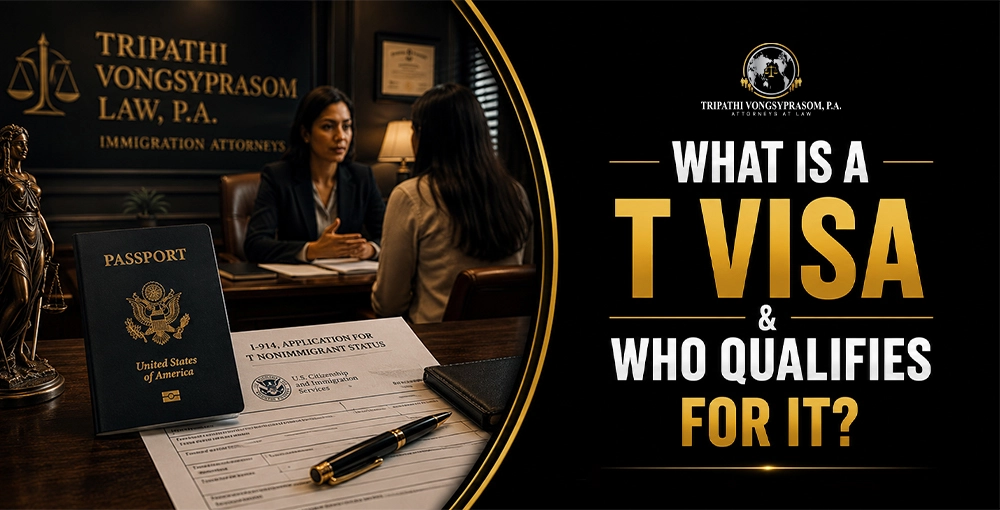
Professional immigration law graphic illustrating the T Visa application process and eligibility requirements for victims of human trafficking. The image features an immigration attorney consultation, a U.S. passport, Form I-914 Application for T Nonimmigrant Status, and legal documents, highlighting how experienced immigration lawyers help eligible individuals obtain protection and lawful status in the United States.
TripVien Law | Immigration
What Is a T Visa and Who Qualifies for It?
TripVien Law, P.A. | Published: July 21, 2026 | Updated: July 21, 2026
Quick Answer
A T visa is a federal immigration status for victims of trafficking who have been brought to the United States by the trafficking. It provides as much as four years of legal status, work authorization and a path to a green card. Often without requiring a referral from an attorney or law enforcement.
Key Points
- Open to both sex trafficking and labor trafficking survivors, including U.S. citizens' family members
- Caps out at 5,000 principal visas per year, a limit that has never actually been hit
- Cooperation with police is usually required, but minors and trauma survivors are exempt
- Interim work permits now arrive faster through the 2024 bona fide determination process
- Leads to permanent residency after three years in T status, sometimes sooner
1. Federal Law Draws a Hard Line on What Counts as Trafficking
Look, human trafficking isn't some vague, blurry concept. The federal government splits it right down the middle into two distinct categories: sex trafficking and labor trafficking. Sex trafficking means a person was brought in, hidden away, or moved around for commercial acts using force, fraud, or outright coercion. And if someone is under 18, consent doesn't even enter the equation. It's trafficking plain and simple. Labor trafficking is about forcing people to work through threats, trickery and debt or physical walls.
Down here in the Sunshine State, we look at it the exact same way. Florida Statute 787.06 treats trafficking for labor or sex as a massive first degree felony. Now, state prosecutors and federal immigration folks might not always be sitting at the same table on every single case, but the facts of what happened? They overlap. And that overlap is exactly what a good T visa attorney looks for to build a rock solid federal application.
Please, Don't Wait for a Police Report to Start Your Journey
For a moment, let's shed some light on debt bondage, as many people are unaware that they are experiencing it. A bad actor steps up and pays for your travel, your room or your food and then they keep adding numbers to the ledger so the debt never goes away. That’s labor trafficking under federal law, full stop. No one ever has to raise a hand or throw a punch for it to be a crime.
2. Who Actually Qualifies for a T Visa?
USCIS applies five requirements, and an applicant has to clear every one of them. Skip a single element and the petition gets denied, which is exactly why self-filing a T visa case is a bad idea.
T VISA ELIGIBILITY CHECKLIST
- You survived sex trafficking or labor trafficking as defined under federal law
- You are physically present in the U.S. because of that trafficking
- You cooperated with reasonable law enforcement requests, or qualify for an exception
- Removal from the U.S. would cause you extreme and unusual hardship
- You are admissible to the U.S., or eligible for a waiver of inadmissibility
Family members count too. A T-1 principal applicant can bring a spouse, unmarried children under 21, and in some cases parents and siblings along as derivatives. None of those family slots count against the federal cap, which is one reason the T visa program has never actually run out of room.
3. Florida Sees More of This Struggle Than Just About Anywhere Else
It breaks your heart to say it, but Florida ranks third in the entire nation for calls made to the National Human Trafficking Hotline, sitting right behind California and Texas. Think about it, our beautiful tourist spots, thousands of miles of coastline and the regular arrival of seasonal workers for our fields and hotels create the exact kind of shadows that traffickers love to operate in. Florida's own data on county-level reporting shows the highest concentrations in South Florida and the I-4 corridor, the same stretch where our Lakeland office sits.
By The Numbers
3rd
Florida's national rank for trafficking hotline calls
74%
of certified T-1 cases involve labor trafficking
5,000
T visa cap per year, never once reached
Labor trafficking gets overlooked in the public conversation, but it dominates the certified case data. USCIS reports labor trafficking as the identified form in 74 percent of T-1 cases that included a law law enforcement declaration. It’s something we see every year in the citrus groves, hotel lobbies, busy construction sites and behind the locked doors of domestic work.
4. How Long Can the T Visa Process Take in 2026?
Let’s share some genuinely good news. Filing Form I-914 doesn't mean your whole life has to sit on a shelf for years anymore. As we stand here in May 2026, it takes USCIS about 29.5 months to hand down what they call a "bona fide determination." That’s the golden milestone that grants you deferred action and a real work permit while they finish looking at your full case. That’s all thanks to a big federal rule change back in 2024 and it’s easily the finest upgrade this program has seen in a long, long time.
Full adjudication of the underlying I-914 still runs another two to three years on top of that. There is no premium processing option for T visas, so paying extra will not speed anything up. What actually moves the needle is filing a complete package the first time, since a Request for Evidence resets the clock and adds months nobody has to spare.
Survivor Insight
"Survivors come to us assuming they already missed their window because they never called police. In most of these cases, that assumption is wrong, and it costs people months they did not need to lose."
- Viengphone Vongsyprasom, Tripathi Vongsyprasom Law, P.A.
Trafficking Cases Are Time-Sensitive and Evidence-Heavy
Our immigration team builds T visa petitions designed to clear USCIS the first time.
Schedule a Free Consultation >>5. The Benefits Go Well Beyond a Work Permit
A T visa is not just paperwork that keeps someone from being removed. It rebuilds an entire legal life from a position that was deliberately stripped of options.
| Benefit | What It Means |
|---|---|
| Status duration | Up to 4 years, extendable in qualifying circumstances |
| Work authorization | EAD issued automatically to approved T-1 principals |
| Family protection | Derivative status for spouse, children, and select relatives |
| Federal benefits | Access to certain public benefits same as refugees |
| Path to green card | Eligible after 3 years of continuous T status |
There is also relief that survivors rarely know to ask about. The federal Trafficking Survivors' Relief Act of 2026 now lets survivors clear federal criminal records that came directly from their exploitation, records that traffickers often force victims to accumulate. There’s no reason that someone should be stuck in the system because of a criminal history related to trafficking.
6. What If You Can't Cooperate With the Police?
This stops more survivors from applying than anything else. Plenty of people assume no police report means no case. That is false, and the exceptions exist for good reason.
| MYTH | FACT |
|---|---|
| You must report to police before applying. | Cooperation helps, but minors and trauma survivors are exempt by law. |
| Only foreign nationals smuggled into the U.S. qualify. | U.S. citizens can be trafficking victims too, just not T visa applicants themselves. |
| A criminal record automatically disqualifies you. | Waivers exist, and new relief now addresses trafficking-related records. |
| T visas are nearly impossible to win. | Approval rates run between 55 and 65 percent with solid documentation. |
You Don't Have to Untangle This Alone
Tripathi Vongsyprasom Law, P.A. represents trafficking survivors across Florida with confidentiality and direct, federal-level experience.
Get Your Free Case Review >>Frequently Asked Questions
FAQs About T Visa Eligibility and Qualification
Q: Will my trafficker find out that I applied for a T visa?
Q: What exactly counts as "extreme hardship" to qualify?
Q: Can I travel outside the US if my T visa is approved?
Q: Can people with T visas apply for federal financial aid (FAFSA) for higher education?
Q: If someone broke immigration laws before, are they still eligible?
Disclaimer: This blog post is for informational purposes only and does not constitute legal advice. For specific guidance on your case, please consult with a licensed attorney.